

REVIEW · GETTYSBURG BATTLEFIELD TOURS
Gettysburg Downtown Self-Guided Walking Audio Tour
Gettysburg’s downtown packs a lot into one walk. This self-guided audio tour uses hands-free location-based playback, plus videos and text, so the town feels like a living timeline. I like the lifetime access and the professionally narrated stories, and I also appreciate how easy it is to start, pause, and take breaks at your own pace. One consideration: if your phone struggles with GPS accuracy or street noise, it can get harder to match where you are to what you hear.
You’ll start at the Gettysburg Heritage Center (297 Steinwehr Ave) and work through major stops tied to everyday people, not just generals and troop movements. The route is about 1 mile+ and typically takes 1 to 2 hours, with around 5 minutes of audio per stop. Just remember: admission tickets for the listed attractions are not included, so plan for either quick exterior looks or extra time (and cost) if you want to go inside.
Key Points Before You Walk

- Offline maps and offline audio after you download, so you can keep going even with spotty cell service
- Location-based playback that runs automatically once you start at the right spot in the app
- 12 downtown stops covering houses, cemeteries, a courthouse, and postwar veterans’ support
- Lifetime access with no expiry, so you can listen again later on another visit
- Flexible timing (use it any day, any time) with a start-and-pause approach that suits slow walkers and snack breaks
- Support available by phone, email, or chat if audio or navigation acts up
Other ways onto the battlefield
Price and Time: Why This Tour Often Feels Worth It

At $9.99 per person, this is one of the cheaper ways to get a structured Gettysburg walk without committing to a specific tour time. What makes it feel like good value is not just the cost, it’s the format: you are buying a complete, narrated route that you can repeat anytime thanks to lifetime access and no expiry.
The pace is realistic. Plan on roughly 1 to 2 hours for an over-1 mile loop through downtown stops, with more than 21 audio stories along the way. Even if you move briskly, you still get time at each point to read, look around, and decide whether you want to linger in shops or step into a site.
The main trade-off with a self-guided audio tour is that you are the group leader. If you want constant, live interpretation on the spot, this won’t replace that. But for short on time days, it’s a strong way to build context before you move on to the bigger Gettysburg landmarks.
How the App Works When GPS and Street Noise Compete
This tour is run through the Action Tour Guide App. After booking, you get setup instructions and a password by email and text, and you download the tour while you are on strong Wi-Fi or cellular. After that, it works offline. That matters in Gettysburg, where you can still get service in town, but not everywhere, all the time.
The audio plays based on your location, so the basic approach is simple:
- Get to the start point at the Gettysburg Heritage Center.
- Open the app on site and launch the correct tour version.
- Start at the first story point and follow the audio cues.
Here’s where your experience can go either smoothly or frustratingly. A couple of common problems show up with these sorts of location-based tours:
- If GPS pin-pointing is off, the audio may feel like it’s not matching where you are standing.
- If the street is loud, it can be tough to hear the narration while you are walking and browsing.
My practical fix is to slow down at each stop, stand still for 20 to 30 seconds, and let the audio catch up. If you run into a mismatch, you can pause, read the app map, and then restart when you’re closer to the next story point. Also, keeping the phone volume up and your screen brightness reasonable helps a lot.
Device guidance is given too. For best navigation, the tour recommends an iPhone on iOS 15 or later, Android version 9 or later, or an iPad/tablet with GPS and cellular connectivity.
Walk the Downtown in the Right Order, for Real Meaning

This route is designed as a connected storyline. The stops are short, around 5 minutes each, which keeps your energy up and helps you avoid the classic problem of spending an hour stuck at one spot.
Most stops are likely viewable from the outside, but admission tickets are not included at any of them. So if a stop matters to you, check whether you plan to buy entry. If not, you can still benefit from the audio context, because it explains what happened and what to look for even when you are not paying to go inside.
One more planning note: the route is self-guided and returns back to the starting point per the tour info. Still, some people experience it like a one-way walk because downtown legs add up, and it often feels natural to keep walking after you finish. Bring water and expect a downtown walking rhythm.
More walking, less waiting
- Gettysburg: 1863 Historic Downtown Walking Tour★ 4.9 · 306 reviews
- Gettysburg One-Hour Walking Tour: The Civilian Experience★ 5.0 · 121 reviews
- Gettysburg: The Civilian Experience Guided Walking Tour★ 4.8 · 65 reviews
- Gettysburg One-Hour Walking Tour: Danger & Courage★ 4.5 · 47 reviews
- Gettysburg: Beer, Wine, and History Guided Walking Tour★ 4.3 · 41 reviews
Stop-by-Stop Gettysburg: 12 Places Tied to People, Not Just Battles

1) Jennie Wade House: A Household Under Threat
Jennie Wade’s story centers on fear and everyday courage as Confederate troops advanced in 1863. When Jennie Wade and her mother fled to a relative’s home with Georgia, they were terrified of what the coming battle could mean for their town. The audio leans into the anxiety of expecting violence at the door with bayonets drawn.
If you care about the human scale of the Gettysburg story, this is a great opener. It sets the tone that Gettysburg was not only a battlefield, it was also a place of neighbors trying to survive the shock.
2) Gettysburg National Cemetery: Graves Rushed Into the Ground
At the cemetery, the audio focuses on burial urgency. Teams of soldiers buried men where they had fallen, union and Confederate alike, and many graves were only about 12 inches deep. The point is blunt: the armies had battles to fight and no time for proper burial.
This stop can feel heavy, but it also makes Gettysburg make more sense. You start to understand why the town remembered so intensely afterward, and why the cemetery became such an important marker of loss.
3) Tillie Pierce House Inn: Curiosity Meets Cannon Fire
This stop highlights Hettie Shriver and the 15-year-old neighbor Tillie Pierce. Tillie is portrayed as fascinated by the spectacle, even standing outside to watch Union soldiers ride by. Once the cannons begin booming, her sense of safety collapses, and the horrors keep following her even when she flees with Hettie.
It’s a strong reminder that war does not only arrive with marching columns. It also shows up as sound, rumors, and the sudden shift from watching to surviving.
4) Gettysburg Heritage Center: The Town Beyond the Battlefield
This is where you zoom out from the fighting and look at Gettysburg’s broader story. The audio explains that yes, the battle put Gettysburg on the map, but there were many other stories worth telling, especially the daily lives of people caught in it all.
Even if you do not go far inside any building, this stop helps you connect the earlier homes and later memorials into one theme: ordinary life disrupted, then reshaped.
5) Gettysburg Museum of History: Artifacts and the Problem of Missing Pieces
Here you get a big collection and a messy reality. The museum’s private holdings include more than 4,000 Civil War artifacts, which is a standout number for a tour stop. The audio also addresses looting, noting that even with efforts by residents and government in 1863, some bodies and bits of gear were left on the battlefield and later disappeared over time.
If you want more than just dates and tactics, this stop adds friction in a useful way. You see how the war’s physical leftovers became part history and part mystery.
6) Witness Tree: Lincoln’s Route in One Tree
The Witness Tree stop ties the landscape to a famous trip. The audio notes that Abraham Lincoln rode directly past this tree on the way to deliver the Gettysburg Address.
This is one of those moments where you feel the weight of “right place, right moment.” Even a short audio stop like this can give you a clearer sense of the route Lincoln took and how the town’s streets became part of the speech’s backdrop.
7) Adams County Courthouse: A Building Turned Into a Hospital
In the courthouse story, the theme is improvisation under pressure. When the battle raged around residents and wounded soldiers piled up, buildings became hospitals, including this courthouse. The audio describes doctors doing what they could to tend to injuries despite the chaos.
This stop adds context to why Gettysburg is remembered not only for strategy, but also for suffering and triage. It’s a practical bridge between battlefield action and civilian infrastructure.
8) Shriver House Museum: Hettie Shriver’s Aftermath
This stop returns to Hettie Shriver, described as mild-mannered and caught in a familiar Gettysburg pattern after the fighting started. Hettie decides to flee with her family to her parents’ farm three miles south of town.
The audio here is useful if you want to understand what happened after the moment of fear. The stories help you track how people moved, hid, and tried to outlast the most frightening part of the campaign.
9) David Wills House: The Attorney Behind the Cemetery
David Wills appears as more than a name on a plaque. The audio frames him as a Gettysburg community pillar and the man responsible for organizing the creation of the Gettysburg National Cemetery.
This stop is valuable because it explains what comes after grief. Someone had to shape remembrance into an actual place, with decisions and logistics, not just emotion.
10) Hotel Gettysburg: From Tavern Days to a Historic Address
The Hotel Gettysburg story reaches farther back than the battle. The building dates to 1797 and started as a humble tavern. At one time, it was owned by the prominent McClellan family, adding a layer of national connection beyond Gettysburg’s borders.
Even if you only look at it from outside, it’s a good reminder that Gettysburg was already an established town before 1863. The battle became the headline, but the town had a long civic and business life.
11) Lincoln Statue at Wills House: The Common Man Concept
This stop focuses on an idea, not a celebrity. The Lincoln statue shown next to him features no name, with the concept being the common man. The audio connects this symbol to the continued importance of Gettysburg and Lincoln for everyday people in the modern era.
This one can spark good reflections during your walk, especially if you have been thinking of Lincoln only as a history-book figure. Here, the emphasis is on how symbolism lives on after the speeches and marching stops.
12) G.A.R. Hall: Postwar Support for Union Veterans
The final stop turns toward what happened after the guns. GAR Hall is the Grand Army of the Republic building, created by the government to support Union veterans. The audio notes that veterans gathered, shared stories, and looked after one another in times of need.
This ending gives your walk closure. You finish at a place built for reunion and support, not for battle memories alone.
Practical Tips to Make It Smooth (Especially if You’re Hearing in the Streets)

I would do these things before you start moving:
- Download the tour on strong Wi-Fi or cellular first, then use offline audio afterward.
- Start on time and do not multitask right at the first story point. The tour is designed to begin correctly so location-based playback stays aligned.
- At each stop, give yourself a short pause. Stand, listen, and then move on when the next cue is ready.
If you find you cannot hear narration over traffic or crowd noise, hold your device closer, raise volume, and step a few feet away from the noisiest sidewalk spots. This matters because some downtown blocks can be loud while you browse shops or wait at crossings.
Also, if you are sharing the experience with someone, it helps to plan headphone sharing. Couples can share one tour by splitting headphones, which can save money if you both want the same route.
Should You Book This Gettysburg Downtown Self-Guided Tour?

Book it if you want a structured, affordable way to understand Gettysburg downtown in about 1 to 2 hours. The lifetime access is a big plus if you are the type who likes to revisit places later, or if you want a plan for your next trip without paying again. It also fits well if you like walking at your own pace and stopping for photos, snacks, and quick browsing.
Skip it or consider a live tour instead if you strongly prefer human interaction, or if you know you struggle with app navigation and location-based playback. In a self-guided format, street noise and imperfect GPS can make the narration harder to use, and you might miss some cues about what to notice.
If your goal is quick context before deeper Gettysburg sites, this tour is a sensible choice. It gives you people-centered stories, short stops, and a route that helps you see more than you would on your own.
FAQ

How long does the Gettysburg Downtown Self-Guided Walking Audio Tour take?
It typically takes about 1 to 2 hours, and the route is over 1 mile long.
What does the tour cost?
The price is $9.99 per person.
What language is the narration available in?
The tour is offered in English.
Do I need an admission ticket for the attractions on the route?
No. Attraction passes, entry tickets, or reservations are not included, and the listed stops note that admission tickets are not included.
Do I need cellular data to use the tour?
You must download the tour while you are on strong Wi-Fi or cellular. After downloading, it works offline.
Where does the tour start?
The tour starts at Gettysburg Heritage Center, 297 Steinwehr Ave, Gettysburg, PA 17325, USA.
Is support available if the audio or app has issues?
Yes. You get instant support via phone, email, or chat when you need it.
More Tour Reviews in Gettysburg
- 2-Hour Gettysburg Battlefield Guided History Bus Tour with a National Park Guide
★ 4.5 · 2,201 reviews





Gettysburg, Other Ways In
- 2-Hour Gettysburg Battlefield Guided History Bus Tour with a National Park Guide
★ 4.5 · 2,201 reviews

More to book around Gettysburg
- 1 Hour Gettysburg Haunted Farm Tour
★ 5.0 · 4 reviews - Wonder Women of Gettysburg Hidden Valor By Junket
★ 4.5 · 7 reviews - Mystery!: A Gettysburg Evening Walking Tour
★ 5.0 · 6 reviews - Secrets of Gettysburg Untold Stories: Beyond the Battlefield Tour
★ 5.0 · 4 reviews - Haunted Smart Phone App Location Aware Walking Tour in Gettysburg
★ 4.5 · 8 reviews - Civil War Battlefields Self-Guided Audio Driving Tour Bundle
★ 4.0 · 5 reviews
Gettysburg Battlefield Tours, compared.
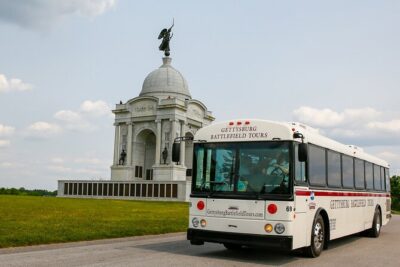 ★ 4.52-Hour Gettysburg Battlefield Guided History Bus Tour with a National Park GuideFrom $432,201 reviews
 ★ 4.5Civil War Ghosts: Echoes of the Fallen Gettysburg Ghost TourFrom $32913 reviews
 ★ 4.5Gettysburg Battlefield Self-Guided Driving Audio TourFrom $16910 reviews
 ★ 4.8Gettysburg: Horse-Drawn Carriage Battlefield TourFrom $74896 reviews
 ★ 4.5Gettysburg: Ghost Hunt Tour with Ghost Hunting EquipmentFrom $28589 reviews
★ 4.3Civil War Ghosts: Echoes of the Fallen Gettysburg Ghost TourFrom $24480 reviews
★ 4.5Gettysburg: Ghost Hunt Tour with Ghost Hunting EquipmentFrom $28589 reviews
★ 4.3Civil War Ghosts: Echoes of the Fallen Gettysburg Ghost TourFrom $24480 reviews
 ★ 4.9Gettysburg: Licensed Guided Battlefield Horseback TourFrom $144419 reviews
 ★ 4.5Ghost Tour: History and Haunts – Family Friendly – Best in GettysburgFrom $23378 reviews
Browse the lists this tour appears in