
REVIEW · HISTORICAL TOURS
Washington DC History of Slavery Walking Tour
DC has slavery built into its sidewalks. This private tour uses Lafayette Square as the starting point to connect DC landmarks to the reality of slavery.
I love the tight, stop-and-talk pacing that keeps you learning without feeling rushed, especially at Decatur House and the C & O Canal area. I also like that you’re guided by a specialist who brings the stories to life in an approachable way, with the occasional interactive moment like quick questions and visuals shared during the walk.
One consideration is simple: it’s weather dependent and it’s still a walk, so plan on comfortable shoes and a relaxed pace.
Key Things That Make This Tour Worth It
- A focused 1-hour route through major DC sites tied to African American history and slavery
- Private group format so your guide can slow down, answer questions, and tailor the discussion
- Specialist-led storytelling, with guides like Dr. Koura and Dr. Gibson getting strong praise for teaching style
- Free access at the stops, which helps you feel like you’re spending money on the guide, not entry fees
- Mobile ticket convenience, plus it ends right near the National Museum of African American History and Culture
More walking, less waiting



A 1-Hour Route That Feels Like More Than Time
This is one of those DC tours that respects your schedule. About an hour total, it threads through a handful of high-impact sites without turning into a marathon.
What makes the experience feel worth the time is how the stops are chosen. You go from a prominent public square to a famous historic house tied to enslaved people, then onto the National Mall area, the canal corridor, and finally the museum landmark. Each location is a prompt, and your guide turns that prompt into context you usually do not get in a standard sightseeing sweep.
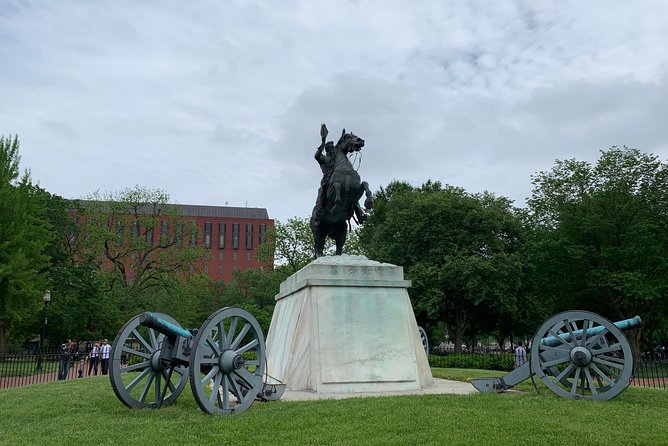
Start Smart at Lafayette Square, Pennsylvania Ave, and 16th Street
You begin at Lafayette Square, at the intersection of Pennsylvania Ave NW and 16th St NW. It is a very recognizable start point, which matters in DC where meeting spots can be oddly specific.
From here, the tour immediately leans into a key idea: the history is not tucked away in a far corner. It is embedded in the landscape. Your guide frames the square as a place where slavery history can be examined, right in the center of everything.
What you’ll feel at this stop
- A quick but meaningful set-up for how the rest of the route connects
- A reminder that official-looking architecture and government landmarks do not tell the full story by themselves
- Discussion that helps you see the city as a layered record, not just a photo backdrop
Deeper into the record
- Guided African American History Tour with Reserved Museum Entry★ 4.5 · 1,180 reviews
- DC Monuments & History Guided E-Cart Tour-Blankets★ 4.5 · 450 reviews
- Smithsonian Museum of Natural History – Exclusive Guided Tour★ 5.0 · 446 reviews
- African American History Tour with Museum of African American History Ticket★ 4.5 · 390 reviews
- Historic Georgetown: History, Gossip, & Architecture Walking Tour★ 5.0 · 321 reviews
Possible drawback
If you prefer purely outdoor stops with no interpretation, this start might feel heavier than a casual landmark walk. But that weight is the point.
Decatur House and the “Slave Pen” Stop That Lands Hard
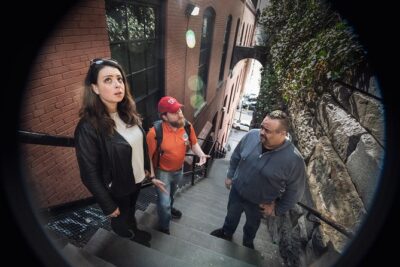
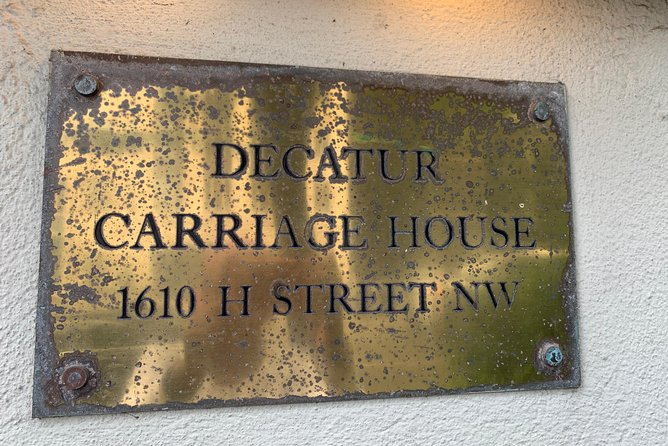
Next up is Decatur House, commonly discussed in connection with a slave pen. The stop lasts about 10 minutes, but it is designed to be dense. This is where the tour shifts from general context to something much more direct and concrete.
Even in a short visit, this stop can change how you understand the surrounding city. Decatur House is not just a building. It is a doorway into how enslaved people were controlled, transferred, and treated as property within the urban system.
Why this stop is so valuable
- It helps you connect slavery history to a physical place, not just a topic
- It gives you a specific anchor point you can remember when you pass similar buildings later
- It reinforces a theme the guide keeps returning to, the difference between what DC signage celebrates and what DC structures concealed
A practical note
Expect the guide to talk. Lafayette Square and Decatur House are both about learning from the street view and the historic setting, so you will be listening more than photographing.
National Mall: A Brief Washington Monument Moment
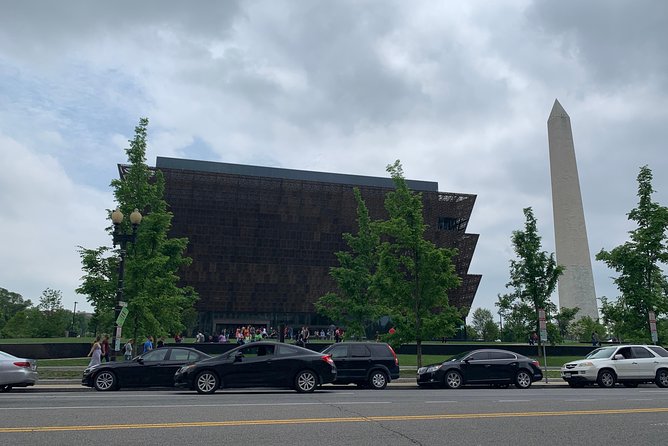
Then you head to the National Mall for a brief stop connected to the Washington Monument area. This segment is about 10 minutes and is intentionally short.
That can be a good thing. The Mall is so packed with attention that you can easily miss the “why it matters” part unless someone gives you the thread. Here, your guide uses the moment to connect African American history to a place that many people only associate with national symbolism.
How to get the most from this stop
- Look around without speeding up. The key details are in what the guide points out.
- Keep an open mind about how different histories can occupy the same public space.
Possible drawback
If you want longer time on the Mall or more time near the monument itself, this tour’s pacing is not built for that. It is designed to move you efficiently from one meaning-rich point to the next.
C and O Canal Lockhouse Near Constitution and 17th
Your route continues to the C & O Canal, with a stop at the lockhouse at Constitution and 17th. Again, this is about 10 minutes.
Canals and waterways sound like “infrastructure” until you realize infrastructure is often part of the story of labor, movement, and the city’s operations. This stop is a chance to see how the shape of DC’s built environment supported systems of work and commerce.
What’s special here
- You get a different kind of setting than a square or a house, so your understanding broadens
- It interrupts the “everything is stone and monuments” feeling of DC tourism
- The guide can help you read the canal as a historical space, not just a walking corridor
Who tends to like this stop
If you enjoy city geography, street-level details, and understanding how locations functioned, you’ll likely enjoy this section a lot.
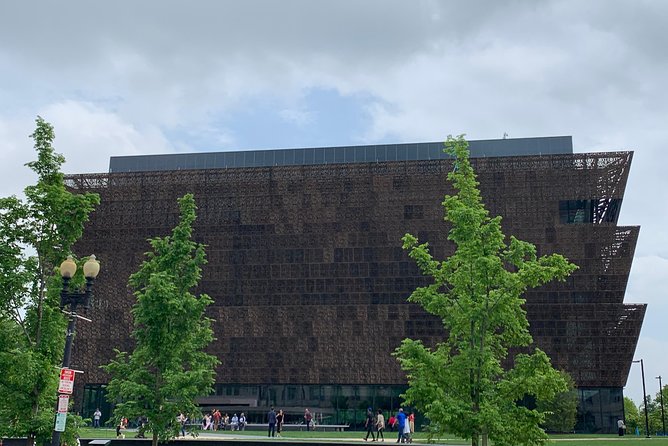
The National Museum of African American History and Culture, Exterior Only
The tour finishes at the National Museum of African American History and Culture area, with a 10-minute outside look at the building architecture. The tour ends on the southeast corner near 15th St.
This is a smart ending. Many people plan museum time but never pair it with a route that prepares their eye. Ending outside the museum gives you a “before” moment: you look at the structure, then you leave with clearer questions to carry into any future visit.
What you’ll take with you
- A better sense of why the museum matters beyond the fact that it is famous
- A feeling that your DC visit is about more than famous dates and famous names
- A stronger framework for understanding what you might see inside later
Practical note
Because this stop is outside, you should not expect the tour to function like an in-museum program. It’s an architectural and contextual wrap-up.
Private Format and Specialist Guides: The Real Value
The price is $40 per person, and the big “value move” here is the private format. In a private tour, your guide is not rushing to satisfy the needs of a crowd. You can ask follow-ups, and your pace can shift.
That matters especially with a topic that deserves attention and careful explanation. Strong reviews repeatedly point to guides such as Dr. Koura and Dr. Gibson for their passion, engagement, and ability to make complex material understandable. One review also mentioned interactive teaching moments like questions and quick quizzes, plus visuals shared through text messaging during the walk. Your group experience can feel more like a guided seminar than a rushed sightseeing act.
Price, Included Fees, and What You’re Really Paying For
At $40, you’re not paying for transportation or for museum entry fees. The tour includes all fees and taxes and the scheduled stops are marked admission ticket free.
So the cost mainly pays for what most people underestimate: time, preparation, and teaching skill. If you’ve ever done a DIY DC day, you already know the problem. You can see the sites. You often cannot connect them into a clear, accurate story.
This tour is built to solve that. You buy the guiding, the interpretation, and the “here is how to look at what you see” part.
Walking Pace, Shoes, and How Families Can Plan
The tour lasts about 1 hour and is clearly designed for walking between nearby areas. Reviews emphasize wearing comfortable shoes and even turning on a fitness app, which is a polite way of saying you will get your steps in.
For families, this can still be workable. One review described a family of 7 that included an infant and praised the easy pacing with frequent educational stops. That suggests the guide keeps things moving but does not run people over.
My practical advice
- Wear shoes you can walk in comfortably for an hour.
- If you’re managing an infant or stroller, be ready to pause naturally, because the whole point is to stop and learn.
- Bring water. Even short city walks add up in DC heat.
Ending Near the Museum: A Smart Way to Continue Your Day
Finishing at the museum makes your schedule easier. You end near 1400 Constitution Ave NW and the southeast corner near 15th St. That gives you flexibility afterward.
If you want to take the next step and go inside the museum, you’re already in the right zone. If you’d rather grab a meal or do more downtown walking, you’re still well placed for transit and daytime wandering.
Who This Tour Fits Best
This walking tour is a good match if you want:
- A one-hour experience that still feels meaningful
- A private group setting where you can ask questions
- A guide who focuses on African American history and slavery connections that often get skipped in standard DC routes
It also tends to suit:
- First-time DC visitors who want a fast, high-context overview
- Couples and small groups who enjoy walking plus discussion
- Families who want a structured learning outing without committing to half a day
If you want a purely scenic, photo-first stroll, this is probably not your best fit. The focus is education and interpretation, not “look at the view” sightseeing.
Booking Timing, Weather, and Common Sense Logistics
This tour is on the smaller-side and you typically see it booked around 31 days in advance. That’s a good sign. Popular guides and narrow time windows often fill up, so if your dates are fixed, book early.
Also plan around weather. The experience requires good weather. If it must be canceled for poor conditions, you should expect an offer of a different date or a full refund.
On the ground, it’s also helpful that the tour is near public transportation and that service animals are allowed.
Should You Book This Washington DC Slavery History Walking Tour?
I’d book it if you want DC history with a clear lens and you care about accuracy, not just aesthetics. For $40, the value comes from the private specialist guidance, the tight itinerary, and the fact that the stops are free to access. You end near one of the most important museums in the country, so your learning day can flow naturally into more exploration.
I would skip it if you dislike walking, need long museum time, or want only light, casual sightseeing. And if you’re sensitive to heavy historical topics, you should know this tour is explicitly built around slavery history, including a “slave pen” stop.
If that all sounds like your kind of DC day, this is one of the more focused ways to learn what the city often does not explain on its own.
FAQ
How long is the Washington DC History of Slavery walking tour?
It runs for about 1 hour.
How much does the tour cost?
The price is $40.00 per person.
Is this a private tour?
Yes. It is a private tour/activity, and only your group participates.
Where do we meet, and where does the tour end?
You start at Lafayette Square, at Pennsylvania Ave NW and 16th St NW, Washington, DC 20001. The tour ends at the National Museum of African American History and Culture, on the southeast corner near 15th St.
What language is the tour offered in?
The tour is offered in English.
Do I receive a mobile ticket?
Yes. It includes a mobile ticket.
Are the stops admission free?
The stops listed are marked admission ticket free, and the tour includes all fees and taxes.
Is it suitable for most travelers, and are service animals allowed?
Most travelers can participate, and service animals are allowed. The experience is near public transportation.
What if the weather is poor?
The tour requires good weather. If it is canceled due to poor weather, you will be offered a different date or a full refund.
What is the cancellation policy?
You can cancel for a full refund if you cancel at least 24 hours in advance of the experience’s start time. If you cancel less than 24 hours before, the amount paid is not refunded.
More Tours in Washington DC





More Tour Reviews in Washington DC
More to book around Washington DC
- The Public Group Scooter Tour of DC’s National Mall
★ 5.0 · 3 reviews - National Mall Highlights with Cherry Blossom & Arlington Cemetery
★ 3.5 · 3 reviews - Private Washington DC Monuments Day or Night Bike Tour
★ 5.0 · 3 reviews - Private Tour with US Capitol Or Archives Or Washington Monument
★ 3.5 · 3 reviews - Washington DC Private Guided Bus Day Tour with Step Off Guide
★ 5.0 · 3 reviews - 3-Hour Small Group Memorial Tour in Washington, D.C.
★ 4.0 · 3 reviews
Historical Tours, compared.
 ★ 4.52-Hour Gettysburg Battlefield Guided History Bus Tour with a National Park GuideFrom $432,201 reviews
 ★ 4.5Guided African American History Tour with Reserved Museum EntryFrom $891,180 reviews
 ★ 4.5DC Monuments & History Guided E-Cart Tour-BlanketsFrom $52450 reviews
 ★ 5.0Smithsonian Museum of Natural History – Exclusive Guided TourFrom $89446 reviews
 ★ 4.5Baltimore’s Historical Sightseeing TourFrom $44437 reviews
 ★ 4.5African American History Tour with Museum of African American History TicketFrom $90390 reviews
 ★ 4.5Ghost Tour: History and Haunts – Family Friendly – Best in GettysburgFrom $23378 reviews
 ★ 5.0Historic Georgetown: History, Gossip, & Architecture Walking TourFrom $49321 reviews
Browse the lists this tour appears in