
Scooters make the National Mall feel manageable. This guided and narrated ride connects major monuments in about 2 hours 30 minutes, using a mobile ticket and keeping the stops tight.
I love the small group size and cap of 16, because you can actually follow the story as you move. I also like the less walking approach, which means more time looking at the big icons and less time waiting for a perfect sidewalk moment.
The main drawback is simple: you need moderate physical fitness, and the tour depends on good weather since you are riding.
Key highlights you will feel on this scooter tour
- White House view from Lafayette Square on the north side, with a classic photo angle
- Augustus Saint-Gaudens Sherman Monument (bronze statue, dedicated in 1903)
- A Soldier’s Journey at Pershing Park at the National World War I Memorial
- Tidal Basin details for cherry blossom season timing and context
- First-time rider friendly pacing with safety and comfort built into the experience
- Small pets may join if you use a proper backpack
Other ways to cover the Mall


Why a scooter works on DC’s National Mall (and why it matters)
DC can be a lot on foot. The National Mall is long, and the sidewalks can turn slow when crowds stack up. On a scooter tour, you trade some of the walking grind for short, focused pauses at the monuments, which is exactly what helps you see more in less time.
This kind of route also changes how you experience the memorials. Instead of running between sites, you get to slow down where it matters, then roll on before you lose momentum. The tour is designed around efficient sighting, but it still builds in time at each stop so the stories have room to land.
Before you start: meeting point, ride time, and what to plan for
Your tour begins at 1012 14th St NW, Washington, DC 20005, starting at 10:00 am. It ends back at the same meeting point, which is handy when you are trying to line up the rest of your day.
Expect about 2 hours 30 minutes of ride time on the route. You are asked for moderate physical fitness, which makes sense because you will be riding and navigating outdoor paths for an extended stretch. This is also for ages 7 and up, and the tour allows service animals.
A nice practical touch is that it uses a mobile ticket, so you should spend less time hunting for paper confirmations. And if you travel with a small pet, the tour notes that you can bring them if you have the right style of backpack.
One more reality check: the experience runs in good weather. If weather is poor, you should expect the operator to offer a different date or a full refund.
White House at Lafayette Square and Sherman Monument, the easy first wins
The tour opens with a strong “wow” stop: the White House seen from Lafayette Square on the north side. You are not staring at a fence from far away. You get the classic sightline of the building’s white exterior and grand columns, plus the landscaped surroundings that make this area feel like more than just a landmark.
Next up is the William Tecumseh Sherman Monument, a bronze statue by sculptor Augustus Saint-Gaudens, dedicated in 1903. Even if you know Sherman mainly from Civil War history, this stop gives you a sense of how DC memorializes military leadership in solid, old-school bronze and stone.
These early stops matter because they set expectations. This is not a slow museum crawl. You are rolling, learning, and then moving on while the lighting and your energy are still good.
Other browsing routes
- National Mall Tour with 10 Stops & U.S. Capitol or Museum Entry★ 4.5 · 331 reviews
- Washington DC: National Mall Night Bus Tour★ 4.6 · 313 reviews
- DC: White House, National Mall and Lincoln Memorial Tour★ 4.1 · 279 reviews
- Celebrate 250th: Washington Monument Ticket & National Mall Tour★ 5.0 · 204 reviews
- Day or Night National Mall Bus Tour with Arlington Cemetery Walk★ 4.5 · 117 reviews
From the Willard InterContinental to the Smithsonian core
A key mid-route historic viewpoint is the Willard InterContinental Hotel, tied to DC’s political and communications story. The hotel traces back to 1847, has hosted presidents, and was a major hub during the Civil War. It is also described as the site of the first telegraph message, which is a great reminder that DC history is not only about speeches and statues.
Then you hit the emotional and cultural anchor of the tour near Pershing Park and the Smithsonian grounds.
At the National World War I Memorial, look for A Soldier’s Journey as the central design. It tells a story in stages, from leaving family to the chaos of combat, loss of comrades, and then returning home after medical care. It is one of those memorial designs that makes the stop feel like a narrative, not just a photo opportunity.
Nearby, you also get a focus on African American history and culture at the National Museum of African American History and Culture. The museum is part of the Smithsonian and the tour describes its role in documenting African American life, history, and culture through artifacts like documents, photographs, and artworks. Even without going deep inside, simply being in the area helps you connect the memorial stops later in the ride.
Finally, there is the Smithsonian Castle, identified as the Smithsonian’s administrative center. The building was designed by James Renwick Jr. and was the first Smithsonian building, which adds extra meaning to the familiar red-brick look you will recognize from photos.
Washington Monument, Tidal Basin, and Thomas Jefferson’s neoclassical pause
The Washington Monument is a straightforward marvel, and the tour gives you solid grounding on it. It was built as a tribute to George Washington, designed by Robert Mills, and constructed between 1848 and 1884. It reaches 555 feet 5 1/8 inches, so you get the scale quickly even during a short pause.
From there, the route shifts to the Tidal Basin, tied to one of DC’s best-known seasonal scenes. The basin covers about 107 acres and is around 10 feet deep. It was built to harness tides from the Potomac to flush silt and sediment, with the water system separating the Washington Channel from the Potomac.
This is also the area most associated with the Cherry Blossom Festival in spring. So even if you are visiting outside peak bloom, the tour framing helps you understand why the basin matters and why people plan entire trips around it.
Then you reach the Thomas Jefferson Memorial, built between 1939 and 1943. It uses a neoclassical style and includes Jefferson quotes intended to capture his political philosophy, often described as Jeffersonian democracy. It is a calm, architectural kind of stop, different from the war memorial pacing.
As the route continues, you also get a sighting of the Pentagon from across the Potomac River. It is described as one of the most recognizable buildings in the world, with five concentric pentagonal rings, so you know exactly what you are looking at.
Martin Luther King Jr. Memorial Bookstore, Korean War Veterans, and the Lincoln pivot
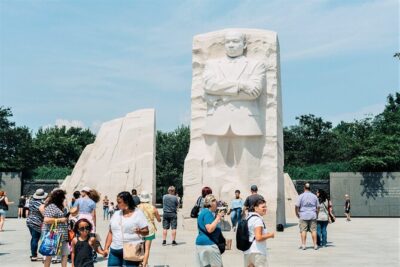
Downtown DC brings you to the Martin Luther King Jr. Memorial Bookstore area. The tour notes that it honors Dr. King’s legacy and his work for freedom, equality, and justice, including efforts for racial equality and support for working-class people and those affected by oppression.
Right after that, there is an additional memorial stop tied to world wars, with an inscription explaining that the names of men and women from the District of Columbia who gave their lives are recorded as a perpetual acknowledgment. Even if you do not read every line, this kind of plaque text changes the tone of a ride, because it makes the remembrance feel local and specific.
Next, the tour includes the Korean War Veterans Memorial. The inscription focuses on honoring sons and daughters who answered a call to defend a country they did not know and people they did not meet. This makes the stop hit with empathy, not just facts.
Then you roll into the Lincoln Memorial. Lincoln is memorialized seated in marble, with the themes emphasized in the tour materials as unity, strength, and wisdom. In practice, this stop is the emotional midpoint of the route because it is both symbolic and visually dominant. It is also the kind of stop where people naturally slow their pace, even on a scooter tour.
Vietnam Veterans Memorial and the World War II Memorial, where time matters
The route finishes with the memorials that ask for patience.
First, you see the Three Servicemen Statue, described as a bronze sculpture at the Vietnam Veterans Memorial area, representing different branches of the U.S. military. It works as a bridge between the names and the more human, person-shaped symbolism of the memorial complex.
Then you reach the Vietnam Veterans Memorial, formed by two black granite walls with the names of more than 58,000 Americans who died or remain missing in the war. The tour also describes a bronze statue of three soldiers and a flagpole, completing the site’s mix of lettering, sculpture, and formal remembrance.
This is the stop where I would tell you to plan your mindset. Even if your ride schedule is tight, the wall layout naturally invites longer looking. If you are someone who likes to read inscriptions, give yourself time here, because the impact is tied to attention.
The final major stop is the World War II Memorial. It uses stone architecture and bronze sculptures to recognize American service, honor those who fell, and highlight the victory tied to restoring freedom and ending tyranny around the globe.
Together, these ending memorials create a powerful arc. The tour moves from broad national landmarks into more personal remembrance, then closes with the big-scale story of WWII service and sacrifice.
How the narration keeps it from feeling like a checklist
The tour is described as guided and narrated, and that matters more than people expect. With a scooter, your eyes move fast. The narration helps you slow down mentally while your body keeps rolling.
The standout practical point here is safety and comfort. One named guide, Barry, is highlighted for making sure first-time scooter riders feel at ease. That same theme shows up in the idea of practicing and getting comfortable before you head out on the route. If you are a nervous rider, that reassurance is not fluff. It changes your whole day.
There is also a clear emotional structure to the storytelling. You start with iconic government buildings, then shift into wars, then into civil rights and remembrance. If you like tours that connect themes, not just stops, you will probably enjoy the flow.
Value check: is a $137 National Mall scooter tour worth it?
The price is listed at $137.00 per group (up to 1), and the tour runs for about 2 hours 30 minutes. Since the stops are tagged with free admission, you are not paying extra entry fees at each monument, which helps keep the budget cleaner.
So what are you paying for? You are paying for:
- Transport that reduces walking time across a long area
- A guide who narrates so the route feels meaningful, not random
- A plan that gets you to multiple major memorials efficiently
- A small-group cap of 16, which helps the experience stay personal enough to be informative
If you are traveling solo, that per-group pricing can still be reasonable because you are buying time and guidance rather than splitting costs among a big group. If you are hoping to minimize total spending, compare it to what you would lose if you walked and waited through crowds, especially on a tight schedule.
Who should book this National Mall scooter tour
This is a good fit if you want:
- An efficient way to see the big memorials without long walking stretches
- A route that mixes famous landmarks with moments of reflection
- A guided ride where you are not stuck guessing what you are looking at
It is also a practical pick if you are traveling with someone who is not thrilled about marathon walking, because the scooter format changes the day from endurance to motion.
You should probably skip it or plan extra caution if:
- You are uncomfortable with scooter riding for extended time
- Your schedule is tight and weather might shift
- You prefer deep museum time rather than short, focused stops (this ride is designed around monument viewing and narration)
Should you book Adventure DC Tricycle Tours for the National Mall?
I think this is worth booking if your top goal is to see the National Mall’s major sights in one smooth run, with a guide adding context and a format that cuts down walking and waiting. The route covers the White House view, Washington Monument, Jefferson, MLK area, and the Vietnam and WWII memorials, which is a lot of ground for a half-day plan.
The decision comes down to one thing: can you handle a scooter-based sightseeing pace for about 2.5 hours, and are you visiting in weather that stays cooperative? If yes, you should feel confident booking.
FAQ
How long is the Public Group Scooter Tour of DC’s National Mall?
It runs for about 2 hours 30 minutes.
What time does the tour start?
The start time is 10:00 am.
Where is the meeting point?
The meeting point is 1012 14th St NW, Washington, DC 20005, USA.
How much does the tour cost?
The price is $137.00 per group (up to 1).
How large is the group?
The tour has a maximum of 16 travelers.
Is the tour suitable for kids?
The tour allows travelers aged 7 years old and above.
Are service animals allowed?
Yes, service animals are allowed.
Can I bring a small pet?
Small pets may accompany you if you have a proper backpack.
Are tickets or admissions required for the stops?
The tour lists admission tickets as free for the stops included.
What happens if the weather is bad?
The experience requires good weather. If it is canceled due to poor weather, you are offered a different date or a full refund.
More Tour Reviews in Washington DC





The Mall, Three More Ways




More to book around Washington DC
- The Public Group Scooter Tour of DC’s National Mall
★ 5.0 · 3 reviews - National Mall Highlights with Cherry Blossom & Arlington Cemetery
★ 3.5 · 3 reviews - Private Washington DC Monuments Day or Night Bike Tour
★ 5.0 · 3 reviews - Private Tour with US Capitol Or Archives Or Washington Monument
★ 3.5 · 3 reviews - Washington DC Private Guided Bus Day Tour with Step Off Guide
★ 5.0 · 3 reviews - 3-Hour Small Group Memorial Tour in Washington, D.C.
★ 4.0 · 3 reviews
National Mall Tours, compared.
 ★ 4.5National Mall Monuments Night Tour with 10+ Stops, Entry TicketsFrom $654,863 reviews
 ★ 5.0Small Group National Mall Night Tour with 10 Top AttractionsFrom $991,658 reviews
 ★ 4.8National Mall Tour by Electric VehicleFrom $591,206 reviews
 ★ 4.5National Mall Tour with 10 Stops & U.S. Capitol or Museum EntryFrom $59331 reviews
 ★ 4.6National Mall Night Bus TourFrom $55313 reviews
 ★ 4.1White House, National Mall and Lincoln Memorial TourFrom $52279 reviews
 ★ 5.0Celebrate 250th: Washington Monument Ticket & National Mall TourFrom $75204 reviews
 ★ 4.5Day or Night National Mall Bus Tour with Arlington Cemetery WalkFrom $55117 reviews
Browse the lists this tour appears in