
REVIEW · TOURS
We the People Tour: The Essence of Liberty
DC hits different when you connect the dots.
This We the People Tour: The Essence of Liberty strings together key places on and around the National Mall, so you get a fast, coherent story of how American ideals get tested and revised. I love that most stops are free to enter, and you’re not spending your day hunting for tickets and lines. I also like the group-discount angle, plus the mobile ticket, which keeps your day smooth and simple.
The one drawback to plan for: the schedule is tight. Most sites are about 15 minutes each, so if you want long, slow time at one specific memorial, you may need to use the option that gives extra time at your preferred stop (and arrange your own ride back).
Key highlights you will actually feel

- A tight National Mall route that connects Congress, presidents, and memorials into one logical walk.
- Most admissions are free, so your value comes from the guidance, not the ticket math.
- National Archives gets real time at about 1 hour 30 minutes, longer than the other stops.
- Memorials with meaningful design details, like the MLK Stone of Hope and the Vietnam Wall components.
- Your guide can shape the moment, including help at the Vietnam Memorial for name-related tributes.
- A tour size up to 56 travelers, so it helps to stay flexible and listen for timing cues.
Also open around Washington DC this week:
What this 4-hour We the People Tour really covers
This is a half-day style tour in Washington DC that focuses on themes you can feel in your feet. You start at 701 15th St NW around 10:00 am, then move through a sequence of iconic locations that trace American government and civil rights from founding ideals to modern remembrance.
The itinerary is built like a narrative. You begin at the seats of power, then shift to memorials that honor people who served, fought, and demanded change. That pacing matters because it prevents the usual DC problem: seeing ten landmarks but remembering nothing beyond photos.
You also get a very practical mix of places:
- Free access for the Capitol, White House stop, WWII Memorial, Jefferson Memorial, MLK Memorial, Lincoln Memorial, and Vietnam Veterans Memorial.
- Paid admission included for the Korean War Veterans Memorial and the National Archives Museum (this one is the long stop).
The tour lasts about 4 hours, but it is not 4 hours of equal weight. The National Archives alone is about 1 hour 30 minutes, meaning the rest of the walk is designed for quick orientation and key photo and learning moments.
Meeting point and how to start the day with less stress
You meet at 701 15th St NW, and the tour begins at 10:00 am. It is near public transportation, so if you are using Metro or a bus, you have a straightforward way to arrive.
The big practical win is the mobile ticket. Since you will be moving through multiple sites, you want your phone ready and your ticket easy to access. If you rely on your battery, bring a small power bank, because you do not want to scramble with a dead screen mid-tour.
Also note this: the tour ends at a different location than where you start. That is normal for a loop, but it means you should have an easy plan for where you are going next. If you are using rideshare or Metro, plan to leave time for a short transition.
And yes, the group size can be up to 56 travelers. That is not “small and cozy,” so go in with the mindset of following your guide’s rhythm and asking questions at stops rather than expecting a one-on-one museum experience.
Capitol Hill and the White House, the quick orientation stops
- DC Memorials Night Tour: Glass-Roof Convertible Upgrade Option★ 4.5 · 6,933 reviews
- National Mall Monuments Night Tour with 10+ Stops, Entry Tickets★ 4.5 · 4,863 reviews
- Washington DC Monuments by Moonlight Tour by Trolley★ 4.5 · 3,956 reviews
- Hop-on Hop-off Sightseeing Tour by Open-top Bus with 18 Stops★ 3.5 · 3,848 reviews
- Washington DC in One Day: Guided Sightseeing Tour★ 4.5 · 3,360 reviews
United States Capitol: where the system runs
Your first stop is the United States Capitol, the home of the U.S. Congress and the seat of the legislative branch. It sits on Capitol Hill near the National Mall, and it is also tied to Washington DC’s street-numbering logic and quadrant layout.
What makes this a good opening stop is that it sets the theme. Before you get to monuments, you get grounded in what the government does. Even in about 15 minutes, you can connect the idea of liberty to the actual machinery of lawmaking.
A consideration: with only around 15 minutes, you will not get deep interior exploring here unless your experience includes it as part of the stop time. Treat it as a launch point, not the full Capitol visit.
White House: presidents as both people and symbol
Next is the White House, the official residence and workplace of the president. It has been home to every U.S. president since John Adams in 1800, and the phrase White House also works as a shorthand for the president and advisers.
This stop pairs well with the Capitol because it shows the second major pillar of the national government: executive leadership. You are seeing two different branches back to back, with the theme of liberty and governance sitting in the background.
Again, you get about 15 minutes. Use it for your orientation photos and for learning the context your guide gives you, then move on. The real “slow time” is later at National Archives.
WWII through MLK and the Korean War, how remembrance tells a story

National World War II Memorial: design details that carry meaning
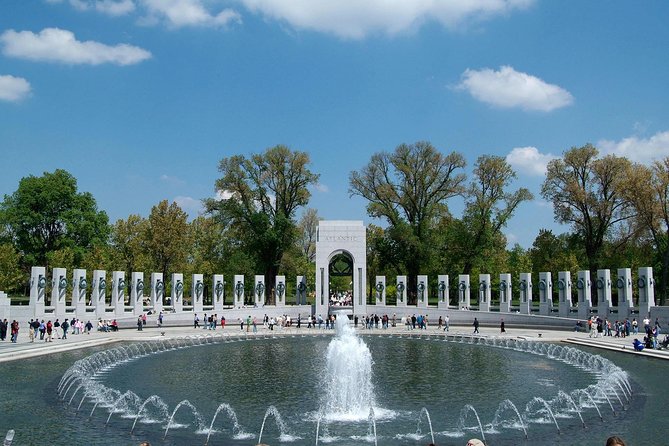
The National World War II Memorial sits on the National Mall near the Reflecting Pool area, between the Lincoln Memorial and the Washington Monument. It is dedicated to Americans who served in the armed forces and as civilians during World War II.
The layout matters here: it has 56 pillars and a pair of small triumphal arches surrounding a square and fountain. You also get the fact that it sits on the former site of the Rainbow Pool. Those are the kinds of details that make a quick stop more memorable than just looking at stone.
Fifteen minutes is enough time to learn the “what it is” and “why it is shaped this way.” If you want extra quiet time, you may want to return on your own later.
Jefferson Memorial: the Declaration voice in stone
The next stop is the Jefferson Memorial, dedicated to Thomas Jefferson, the main drafter and writer of the Declaration of Independence. The memorial also recognizes his broader impact, including his role as the second vice president, later president, and founder of the University of Virginia.
This is a smart pairing after WWII because it snaps you back toward the roots. You are not only honoring sacrifice. You are also seeing how founding documents become living reference points.
Fifteen minutes works if your goal is understanding the symbols and absorbing a few key facts your guide explains.
Martin Luther King, Jr. Memorial: the Stone of Hope concept
Then you reach the Martin Luther King, Jr. Memorial, set in West Potomac Park next to the National Mall. It covers four acres, and the design includes the Stone of Hope, a granite statue carved by sculptor Lei Yixin.
The inspiration is built into the meaning: it is linked to King’s I Have A Dream line, Out of the mountain of despair, a stone of hope. That connection is powerful, and it helps you read the memorial with your mind, not just your eyes.
A practical note: memorials like this can feel emotionally heavy. Fifteen minutes is fine, but be ready for the mood to slow you down. If you are traveling with anyone who gets overwhelmed easily, plan for shorter photo bursts and a quick breather.
Korean War Veterans Memorial: honor in a smaller time window
The Korean War Veterans Memorial is located in West Potomac Park near the Lincoln Memorial and just south of the Reflecting Pool. It memorializes those who served in the Korean War.
This stop is listed with admission included, which matters for value. It also means your time gets organized, rather than you figuring out how to enter a lesser-known stop while keeping pace with the group.
It is still about 15 minutes, so treat it like part of a larger thread, not a standalone museum visit.
Lincoln and Vietnam, the stops that hit hardest
Lincoln Memorial: the symbol, the site, and the debate history
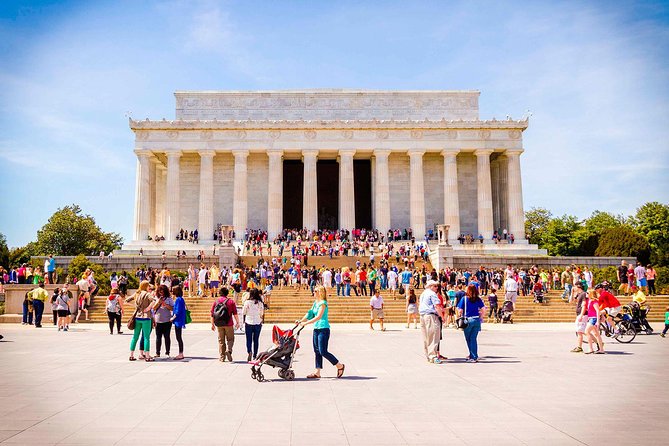
The Lincoln Memorial honors Abraham Lincoln and sits across from the Washington Monument at the west end of the National Mall. The sculptor details are part of what makes it feel like a real crafted monument, including Daniel Chester French’s Lincoln statue and the murals inside.
More importantly, the memorial has long been a symbolic center focused on race relations since the 1930s. That fact changes how you look at it. You are not only seeing a president. You are seeing a public stage where America talks to itself about equality.
Fifteen minutes is enough for a basic orientation and a few big learning points.
Vietnam Veterans Memorial: wall, soldiers, women, and name moments
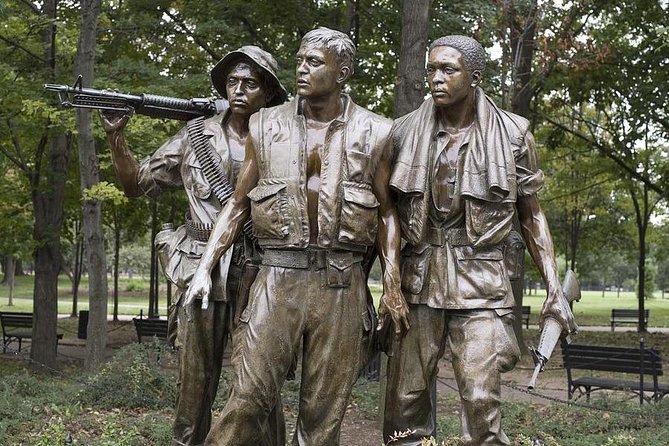
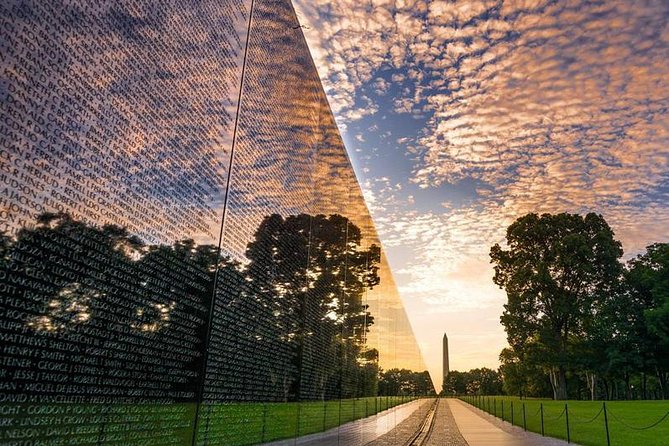
The Vietnam Veterans Memorial is one of the most emotionally complex stops on the route. It honors those who fought, those who died in service, and those who were unaccounted for. It is about two acres, and it includes three parts:
- the Vietnam Veterans Memorial Wall (the best-known part),
- the Three Soldiers,
- and the Vietnam Women’s Memorial.
You also learn that construction and related issues were controversial and led to additions to the memorial complex. That means you are seeing remembrance shaped by public debate.
Here is where the guide quality can matter a lot. In the reviews tied to this tour, one guest described how Brian helped them get an etching of a childhood friend’s name and then paid respects together. If you want to honor someone in a personal way, having a guide who knows how to help you find and handle name-related tribute moments can turn a quick stop into something lasting.
Fifteen minutes is brief for the Wall itself. I’d go in with a plan: decide what you want most, a focused search for names, a quiet read, or a photo with context. Trying to do all three in 15 minutes is a recipe for feeling rushed.
National Archives Museum: the one stop where you slow down
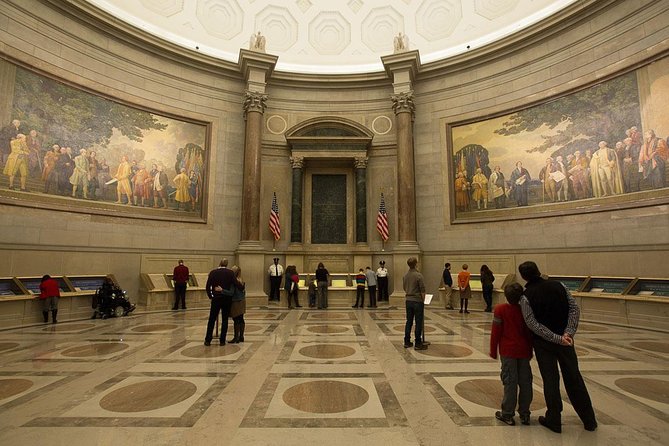
The final major stop is the National Archives Museum, tied to the National Archives and Records Administration (NARA). This is your longest time block at about 1 hour 30 minutes, and it is also the stop with admission included.
This museum is not just about old documents. It is about authority. NARA is responsible for preserving and providing access to government records, including legally authentic copies of acts of Congress, presidential directives, and federal regulations. It also handles Electoral College vote transmission to Congress.
What you get from this ending is a satisfying payoff. Earlier stops are monuments to people, sacrifice, and ideals. National Archives brings you back to the actual words and documents that shape policy and law.
In value terms, this is the best “why pay for the tour” moment. Since the other major stops are mostly free entries, you are paying (via tour cost) for time efficiency and for a guide who can frame how these documents connect to the places you just walked past.
Guide service that changes the feel of the day

One reason this tour consistently earns top marks is the guide team. Multiple reviews highlight Brian and also mention Danny. One review calls out Mr. McCauley by name, describing him as going above and beyond for comfort and helping the day feel fun even when weather turns.
What I think matters most is not just that guides are friendly. It is that they make the day workable:
- you get clear, fast explanations that help you see meaning in what you are looking at,
- you get accommodation for different needs, including help described as front-door style at monuments for older parents,
- and when a stop is personal, like Vietnam, a good guide can help you handle the tribute moment with care instead of rushing you through it.
There is also an energy factor. If you want a guide who can keep the group moving without sounding robotic, the reviews suggest that this is exactly where Liberty Tours DC aims to deliver.
Make the most of 15 minutes per stop

This itinerary wins on focus, but it is still a fast rhythm. A little prep helps you enjoy it instead of just surviving it.
Here are a few practical tactics:
- Pick your priority stop in advance. If you know you want extra time at one location, use the option that gives you more time at a preferred site, and remember you’ll need your own transportation back to your hotel.
- Use the 15 minutes for one goal. A quick photo, a few key facts, or a focused name search at Vietnam. Trying to do everything usually ends with you doing nothing well.
- Plan for emotion at memorials. MLK, Vietnam, and even WWII can slow people down. If you get affected easily, give yourself permission to breathe and take short pauses.
- Wear comfortable walking shoes. You are moving between multiple major DC landmarks. Smooth shoes beat stylish shoes here.
- Keep your phone charged. Since your ticket is mobile, you do not want access problems mid-route.
Who this tour fits best (and who should consider alternatives)
This We the People Tour works best if you want a structured highlights circuit with guiding and context, not a list of monuments you study alone.
It is a solid match for:
- first-timers who want a clear overview of how national government and major memorial themes connect,
- families who want simple timing and a guide to keep things organized,
- and multi-generational groups, including older visitors, since reviews specifically mention ease of access and accommodating help at the monuments.
It may not be your best fit if:
- you want long, quiet time at one memorial,
- you need a fully independent, self-paced visit with no schedule pressure,
- or you dislike walking between sites in a short window.
The group size cap of up to 56 means you should expect a group energy rather than a small intimate tour, even though your guide can still make the experience feel personal at each stop.
Should you book the We the People Tour: The Essence of Liberty?
I think you should book it if your goal is to understand Washington DC quickly and meaningfully. The layout makes sense: start at the Capitol and White House, then move through memorials that tell the country’s story in moments of sacrifice, ideals, and rights. Ending at the National Archives is a smart way to connect monuments back to the documents that power the government.
I would think twice only if your idea of a great DC day is slow museum time at one site. This tour is about momentum and context, with many stops held to about 15 minutes.
If you like guided structure and you want your visit to feel connected rather than random, this is a strong half-day option.
FAQ
How long is the We the People Tour in Washington DC?
The tour lasts about 4 hours.
What stops are included on the tour?
You visit the United States Capitol, the White House, the National World War II Memorial, the Jefferson Memorial, the Martin Luther King, Jr. Memorial, the Korean War Veterans Memorial, the Lincoln Memorial, the Vietnam Veterans Memorial, and the National Archives Museum.
Are admissions included?
Admission is listed as free for most stops, while the Korean War Veterans Memorial and the National Archives Museum are listed as included.
Where do we meet, and when does the tour start?
The meeting point is 701 15th St NW, Washington, DC 20005, and the start time is 10:00 am.
What language is the tour offered in?
The tour is offered in English.
Is a mobile ticket used?
Yes, the tour uses a mobile ticket.
What is the cancellation policy?
You can cancel for a full refund up to 24 hours before the experience start time. The experience also requires good weather, and if it is canceled due to poor weather, you are offered a different date or a full refund.
More Tours in Washington DC





More Tour Reviews in Washington DC
More to book around Washington DC
- The Public Group Scooter Tour of DC’s National Mall
★ 5.0 · 3 reviews - National Mall Highlights with Cherry Blossom & Arlington Cemetery
★ 3.5 · 3 reviews - Private Washington DC Monuments Day or Night Bike Tour
★ 5.0 · 3 reviews - Private Tour with US Capitol Or Archives Or Washington Monument
★ 3.5 · 3 reviews - Washington DC Private Guided Bus Day Tour with Step Off Guide
★ 5.0 · 3 reviews - 3-Hour Small Group Memorial Tour in Washington, D.C.
★ 4.0 · 3 reviews
Tours, compared.
 ★ 4.5DC Memorials Night Tour: Glass-Roof Convertible Upgrade OptionFrom $696,933 reviews
 ★ 4.5National Mall Monuments Night Tour with 10+ Stops, Entry TicketsFrom $654,863 reviews
 ★ 4.5Washington DC Monuments by Moonlight Tour by TrolleyFrom $483,956 reviews
 ★ 3.5Hop-on Hop-off Sightseeing Tour by Open-top Bus with 18 StopsFrom $493,848 reviews
 ★ 4.5Washington DC in One Day: Guided Sightseeing TourFrom $893,360 reviews
 ★ 5.0DC Monuments and Capitol Hill Tour by Electric CartFrom $552,841 reviews
 ★ 5.0Washington DC Moonlight Tour by Electric CartFrom $742,610 reviews
 ★ 4.0Washington DC Hop-On Hop-off Trolley Tour with 15 StopsFrom $482,599 reviews