
REVIEW · WASHINGTON DC MONUMENTS & MEMORIALS TOURS
DC Monuments and Memorials Tour Day Tour
DC can be a lot in one day, so I like tours that make the city make sense fast. This half-day DC monuments and memorials tour strings together the big names with realistic stop times, comfortable van rides, and an audio guide for each location. I especially like the tight group size, max 12, which helps you spend less time waiting and more time looking. I also like the “in the moment” pacing, you get enough time to walk, take photos, and then roll to the next stop. The main drawback to consider is that it is a photo and walking tour, not a museum deep-dive, so if you want long ticket lines and long indoor stays, you will likely want a different format.
I went into this expecting another list of monuments. What surprised me was how the route builds an emotional timeline across war, civil rights, and American leadership, with the Tidal Basin and major landmark exteriors doing the heavy lifting. Your guide for Heart of DC Tours is Kenneth, and the reviews point to his habit of giving clear directions so you can maximize each stop. You will also want to plan for walking time, plus bring your own earbuds since they are not included.
Key things to know before you go
- Max 12 people means fewer delays at each stop and more time actually on the ground
- Audio link for each site helps you understand what you are seeing while you walk
- Air-conditioned vehicle plus bottled water keeps the day comfortable in DC heat
- A tight 4-hour plan hits Jefferson, White House area, major memorials, and the Capitol exterior
- Planned restroom opportunity during the day helps you keep moving
The rest of the marble, compared
A 4-hour route that makes DC feel connected

Washington DC can look like 50 separate attractions until you see them in one arc. This tour runs about four hours, starting at 9:00 am from One CityCenter. The big value here is pacing. You will spend roughly 10 to 20 minutes at most stops, which is just long enough for photos, a quick read of the key elements, and a short walk without turning the day into a marathon.
What I liked about this format is how it reduces decision fatigue. You do not have to figure out which sites go best together. Instead, the route moves logically from landmark to landmark, including the Tidal Basin memorials, then into the war memorial sequence, and ending with the Lincoln Memorial and U.S. Capitol exterior. It is the kind of plan that works well if you have just one day or you want a structured overview before you build a longer itinerary.
For many people, the emotional power hits hardest when you have time to stand still. The stop windows here support that. You are not whisked through like a drive-by. You get enough time to slow down, then get moving again.
Getting started at One CityCenter, and how the day flows
You meet at One CityCenter, 850 10th St NW, and the tour returns to the same meeting point. Starting in the morning matters in DC, both for crowds and for light. If you can, try to arrive a few minutes early so you can settle in before departure.
You ride in an air-conditioned vehicle with bottled water, which is a real help when you are bouncing between outdoor monuments. Since the tour includes an audio link for each site, you are set up to learn without needing to keep an app running nonstop in the background. Also note, there is no WiFi on board, so I would not rely on streaming anything during the ride.
One practical tip: bring your own earbuds if you want private listening. The tour does not include earbuds or headphones, so you either listen out loud from your phone or you bring a simple pair. Small thing, big difference.
Thomas Jefferson Memorial: Pantheon-style calm by the Tidal Basin

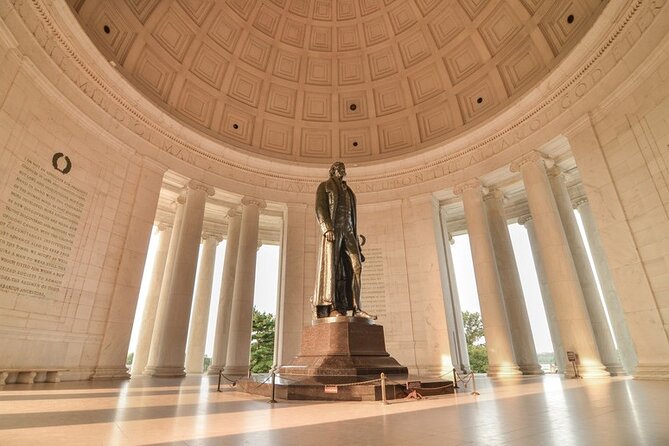
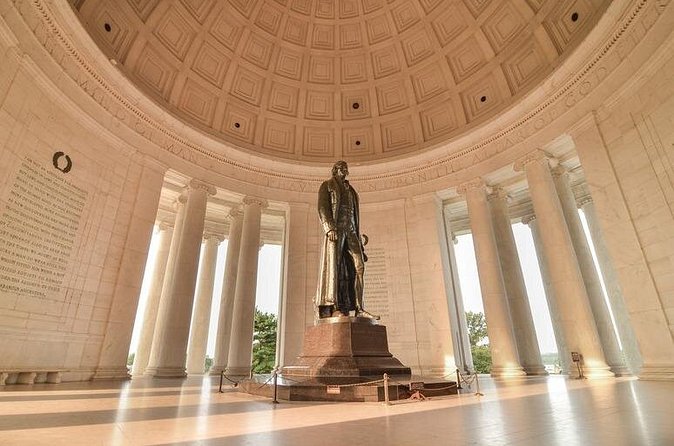
The Thomas Jefferson Memorial is the perfect first stop because it gives you a calm, architectural baseline before the route turns more intense. This memorial sits by the Tidal Basin, and it is modeled on neoclassical inspiration tied to the Pantheon in Rome. The setting matters. You are outdoors, you can breathe, and you can feel the “Washington postcard” vibe without fighting through it right away.
Inside, the centerpiece is a towering Jefferson statue surrounded by excerpts from his writings. That detail turns the visit from “look at the building” into “read what shaped American democracy.” Even if you only catch a few lines, it gives you an anchor for later stops on civil rights and leadership.
You also get a seasonal bonus. During cherry blossom season, the surroundings add a softer mood that makes this memorial feel less like a history stop and more like contemplation. One possible drawback, especially in peak blossom periods, is that the walk around can attract more visitors. Plan to use your time efficiently and focus on the most meaningful viewpoints first.
- DC Memorials Night Tour: Glass-Roof Convertible Upgrade Option★ 4.5 · 6,933 reviews
- National Mall Monuments Night Tour with 10+ Stops, Entry Tickets★ 4.5 · 4,863 reviews
- Washington DC Monuments by Moonlight Tour by Trolley★ 4.5 · 3,956 reviews
- Hop-on Hop-off Sightseeing Tour by Open-top Bus with 18 Stops★ 3.5 · 3,848 reviews
- Washington DC in One Day: Guided Sightseeing Tour★ 4.5 · 3,360 reviews
White House exterior photos, plus what to look for on the Ellipse
Next up is the White House. This is not an inside visit in the way a museum is. Instead, the tour is built around stunning exterior photo opportunities, with angles you can capture from the Ellipse area. The neoclassical building design, paired with manicured lawns and prominent gardens, gives you clean lines for photos.
What makes this stop worth it on a time-limited tour is viewpoint variety. In a short window, you can reposition for better angles and still feel like you “did” the White House. It is also a strong reset point after Jefferson, because it is a visual landmark you immediately recognize, even before you read anything.
Your likely time here is about 10 minutes. That is enough if your goal is photos and a quick look at the building scale. If you want extended time staring at details or doing a long walk around the broader complex, you may feel a bit rushed. Still, as part of a four-hour sequence, it hits the right level.
World War II Memorial: the 56 pillars and the feeling of scale

Then the emotional temperature rises, and it is not subtle. The World War II Memorial is built around 56 pillars symbolizing U.S. states and territories involved in the war. You see the geometry, then you feel the scale. The background elements matter too, with the memorial set near the Reflecting Pool and in view of Lincoln Memorial.
Two features help your brain process the place quickly. First, the pillars give you a countable visual system, so you do not have to interpret everything at once. Second, the mosaics and cascading fountains add texture and movement, so it does not feel like you are staring at a single wall of names. It is a memorial that invites reflection without turning quiet into static.
You typically get about 15 minutes here. I recommend using the first few minutes to locate the main focal points, then stand for a moment where you can take in the whole composition. This is one of those stops where a short pause adds more meaning than stacking more photos.
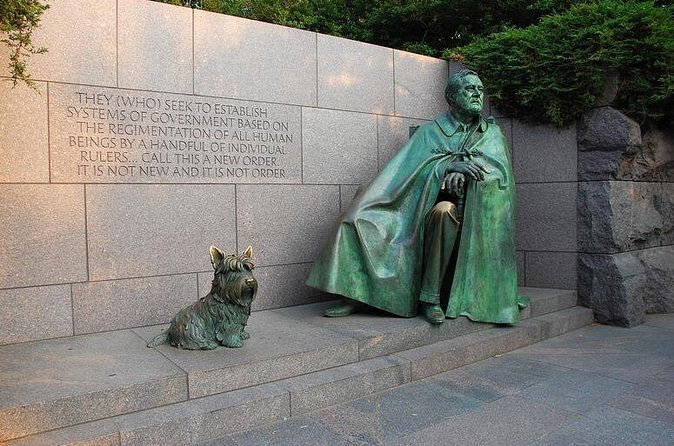
FDR’s memorial: four terms mapped into outdoor storytelling
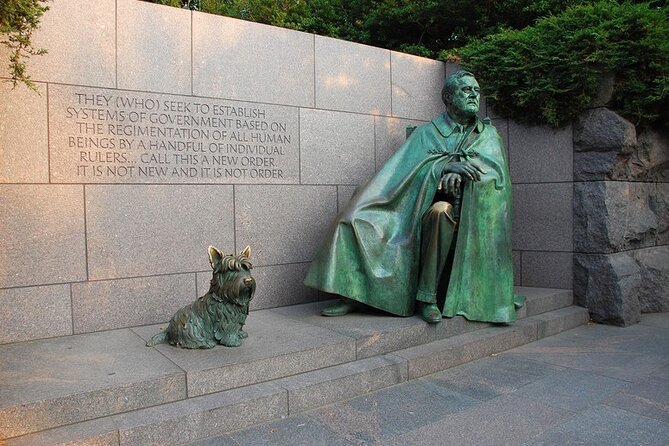
The Franklin Delano Roosevelt Memorial returns you to the Tidal Basin area, which is smart. It gives your eyes a bit of water-and-stone context again, while keeping the narrative moving forward. This memorial is organized into four sections, representing Roosevelt’s four terms.
That structure makes it easier to follow a story in a short visit. Instead of feeling like one large monument, you are walking through chunks. In each section, you will see sculptures and inscriptions tied to Roosevelt’s perseverance during difficult times. The memorial also includes waterfalls that contribute to a reflective atmosphere.
You usually get around 20 minutes at this stop, which is a good amount for outdoor reading and repositioning. If you are the type who reads every inscription, you will still have time to finish a few key ones and not feel like the guide is pushing you along. If you are more photo-focused, you can still enjoy the composition because the sections guide your path naturally.
A small consideration: because it is outdoors and water features exist, you might have slippery patches when conditions are wet. Watch your footing and keep your pace steady.
Martin Luther King, Jr. Memorial: the statue, granite, and the quotes
At the Martin Luther King, Jr. Memorial, the scale changes again. There is a 30-foot statue emerging from granite, and the design makes the leader feel larger than the surrounding space. Around the statue, you will find gardens and quotes tied to his messages of love and equality.
This is one of those stops where the emotional weight is not just in the words. It is in how the site is arranged. The statue placement and the open space around it make it easy to stand where you can read and look without shoulder-checking strangers every few seconds.
You typically get about 15 minutes. That is enough time to read a few quotes carefully, then step back for a wider photo that includes the statue and the surrounding garden framing. If you try to do both full reading and nonstop photo hopping, you will cut your own experience short. I suggest you pick one priority for the first half of your stop, then let the other half happen naturally.
Vietnam Veterans Memorial: black granite names, and the power of standing still
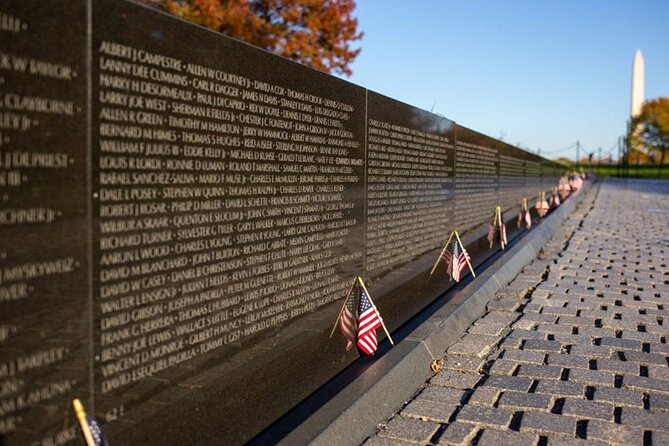
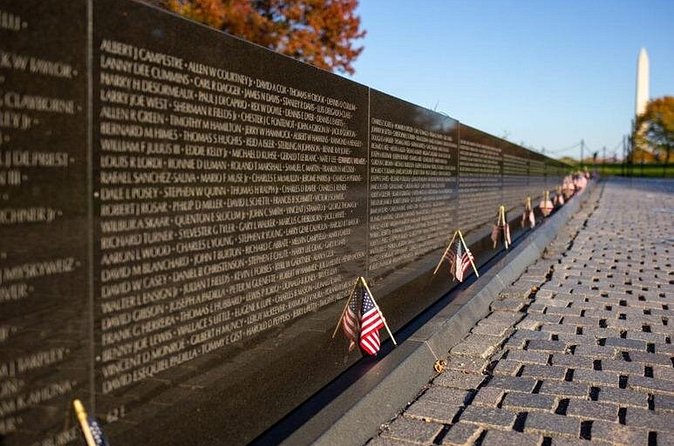
The Vietnam Veterans Memorial is the stop where many people feel the day slow down. The centerpiece is a polished black granite wall inscribed with over 58,000 names of those lost in the war. The wall is the message. There is no grand structure to distract you, which is exactly why it hits so hard.
In the same area, you also have the Three Servicemen Statue and the Vietnam Women’s Memorial nearby. That combination matters because it recognizes different facets of the experience, not just a single version of history.
You usually get about 20 minutes here. I like that duration for this particular site because it gives you room to walk along sections of the wall without feeling like you must race to the “best view.” If you have personal connections or even just a family interest in the subject, more time helps. Even if you do not, you can still spend a few minutes letting your eyes scan, then stop at one section to read more carefully.
The main drawback to consider is emotional. If you are sensitive to heavy themes, this stop may affect your energy for the rest of the tour. That does not mean you should skip it, just plan for it.
Lincoln Memorial: 36 columns, unity, and the steps with meaning
The Lincoln Memorial is iconic for a reason, but it can also be easy to treat like a photo backdrop. This tour format works better if you approach it with a pause. Lincoln’s towering statue is surrounded by classical architecture, and the memorial includes 36 columns, representing the states at the time of his death.
The steps are part of the meaning too. This is the place associated with Dr. King’s famous speech, so the memorial ties leadership and civil rights into one physical location. Even if you know that context already, it lands differently when you are standing in the space.
You typically get about 20 minutes here. That works well because you can do a quick architectural scan, then spend time at the steps and take in the open space. For many visitors, the best photos come from stepping back far enough to include the steps and the statue in one frame, rather than cropping too tightly.
Korean War Veterans Memorial: 19 statues and the reflective wall effect
Next is the Korean War Veterans Memorial, another site where design guides how you feel. The memorial includes 19 stainless steel statues of soldiers set against a black granite wall that mirrors their presence. That reflection is subtle, but it adds a “second layer” to what you see, making the memorial feel more personal.
You also get landscape framing, including juniper bushes, which keeps the site from feeling sterile. It invites quiet reflection and supports a slower pace.
Your time here is usually about 15 minutes. That is enough to walk the main viewpoint, then step aside to see the mirror wall effect from different angles. If you rush through, you miss one of the memorial’s most interesting design ideas.
U.S. Capitol exterior: the dome, gardens, and a best-light moment
The final big landmark stop is the U.S. Capitol exterior west side. Here, you are focused on the architecture, especially the significant dome that symbolizes American democracy. The surrounding gardens and the Reflecting Pool area give you more photo options and natural framing.
If you want your best photos, this is one of the places where timing matters. The description encourages looking in better light, and in practical terms, the building tends to look more dramatic when the sun hits its stone. Even without a perfect “sunset” guarantee, morning light and then late-afternoon light can change how the dome and columns read on camera.
Your time here is short, about 10 minutes. So I recommend choosing your photo spot quickly, then doing a quick look for architectural lines. If you linger only for close-up shots, you might end up with fewer overall views. Quick positioning plus one steady photo usually works best.
The bonus drive-by stops, and why they still help
You also pass by several major landmarks while you travel between stops. Depending on traffic and routing, you may see the Justice Department, Waldorf Historia, the Willard Hotel, the WWI Memorial, and the National Archives. You might also get a chance to stop and use a public restroom during the tour day.
These are not the main focus of the itinerary, so do not treat them like full stops. But the value of drive-bys is orientation. Seeing them on the route helps you understand how the city is laid out, so later you can decide what deserves a return trip.
Also, the travel time itself is part of the experience. In a small vehicle, you are not stuck in a long line of buses. You keep moving and you keep your day organized.
What the audio link adds, and what to bring for it
The tour includes an audio link for each site. In plain terms, it helps you connect images to meaning while you are walking. In one guest’s experience, there was even a QR code that you could scan to listen to the history while walking. That is a great setup because it means you can listen at your own pace and then look around without feeling like you missed a fact.
The one catch is simple: earbuds or headphones are not included. If you do not bring them, you might be stuck listening through your phone speaker, which is not ideal. Bring a pair if you can. Even basic wired earbuds work fine. Also, since there is no WiFi on board, make sure your audio access is ready before you arrive or that your phone plan covers it.
If you like to “read with your eyes,” the audio helps. If you prefer quiet reflection, you can just use the guide facts and still keep the memorial experience respectful and calm.
Price and value: what $89 buys you in DC
At $89 per person for about four hours, this tour is priced for people who want structure without spending all day on logistics. You are paying for a few things that add up fast in DC: transportation in an air-conditioned vehicle, bottled water, a guide who manages timing, and admission tickets for many of the key stops on the route.
For me, the biggest value is time. If you tried to build this exact day yourself, you would still need to map stops, time walks, manage photo positioning, and figure out ticket access where required. The tour reduces that mental load. You also get stop durations that keep the day moving, while still giving enough time at each place to take it in.
The “small group max 12” detail also matters for value. Larger groups spend more time clustering and waiting, which means less quality time at the memorials themselves. Here, the format is set up for speed without feeling like a cattle call, and that is why the reviews lean heavily positive.
Who this tour is for, and who might want a different plan
This is a good fit if:
- You have about half a day in Washington DC and want the major memorials and landmark exteriors.
- You want a guide like Ken or Kenneth to add context without overwhelming you with a full-day museum schedule.
- You like photos but also want meaning behind what you photograph.
It might not be the best fit if:
- You want long indoor time at each place, or you want deep subject study at one site.
- You dislike walking or standing for outdoor stops. There is not a lot of time at each location, but you still will be on your feet.
One of the pleasant surprises from the guide experiences is that it can work well for families, including mixed ages. If you are traveling with kids, a 10 to 20 minute stop pattern can feel more manageable than a long museum block.
Should you book this DC monuments tour?
If you want a smart, efficient day that stitches together Jefferson, the war memorials, civil rights, Lincoln, and the Capitol exterior, this tour makes that easy. I would book it when your time is short and your goal is both photos and context, with a guide who keeps the day organized.
I would not book it if your main goal is extensive indoor touring or long stays at only one or two sites. For everything else, this is the kind of half-day plan that turns “DC is big” into “I saw the major story, in order, without wasting time.”
FAQ
How long is the DC monuments and memorials tour?
The tour lasts about 4 hours.
What time does the tour start?
The start time is 9:00 am.
Where is the meeting point?
The meeting point is One CityCenter, 850 10th St NW, Washington, DC 20001, USA.
How many people are on the tour?
The tour has a maximum of 12 travelers.
What language is the tour offered in?
The tour is offered in English.
Are admission tickets included for the stops?
Admission tickets are included for the listed stops such as the Thomas Jefferson Memorial, the White House, the World War II Memorial, the Franklin Delano Roosevelt Memorial, the Martin Luther King, Jr. Memorial, the Vietnam Veterans Memorial, the Lincoln Memorial, the Korean War Veterans Memorial, and the U.S. Capitol exterior.
What is included in the price besides the guide?
You get an air-conditioned vehicle, bottled water, and an audio link for each site.
Is WiFi available on board?
WiFi on board is not included.
Do I need to bring headphones?
Earbuds or headphones are not included, so you may want to bring your own if you want private audio.
What happens if the weather is bad?
The tour requires good weather. If it is canceled due to poor weather, you will be offered a different date or a full refund.
More Tour Reviews in Washington DC





More Marble in Washington DC



More to book around Washington DC
- The Public Group Scooter Tour of DC’s National Mall
★ 5.0 · 3 reviews - National Mall Highlights with Cherry Blossom & Arlington Cemetery
★ 3.5 · 3 reviews - Private Washington DC Monuments Day or Night Bike Tour
★ 5.0 · 3 reviews - Private Tour with US Capitol Or Archives Or Washington Monument
★ 3.5 · 3 reviews - Washington DC Private Guided Bus Day Tour with Step Off Guide
★ 5.0 · 3 reviews - 3-Hour Small Group Memorial Tour in Washington, D.C.
★ 4.0 · 3 reviews
Washington DC Monuments & Memorials Tours, compared.
 ★ 4.5DC Memorials Night Tour: Glass-Roof Convertible Upgrade OptionFrom $696,933 reviews
 ★ 4.5Washington DC Monuments by Moonlight Tour by TrolleyFrom $483,956 reviews
 ★ 5.0DC Monuments and Capitol Hill Tour by Electric CartFrom $552,841 reviews
 ★ 4.9Washington Monument Direct Entry with GuidebookFrom $25479 reviews
 ★ 4.5No-Wait Washington Monument Direct Entry Tickets & GuidebookFrom $25465 reviews
 ★ 4.5DC Monuments & History Guided E-Cart Tour-BlanketsFrom $52450 reviews
 ★ 4.1White House, National Mall and Lincoln Memorial TourFrom $52279 reviews
 ★ 5.0Celebrate 250th: Washington Monument Ticket & National Mall TourFrom $75204 reviews
Browse the lists this tour appears in